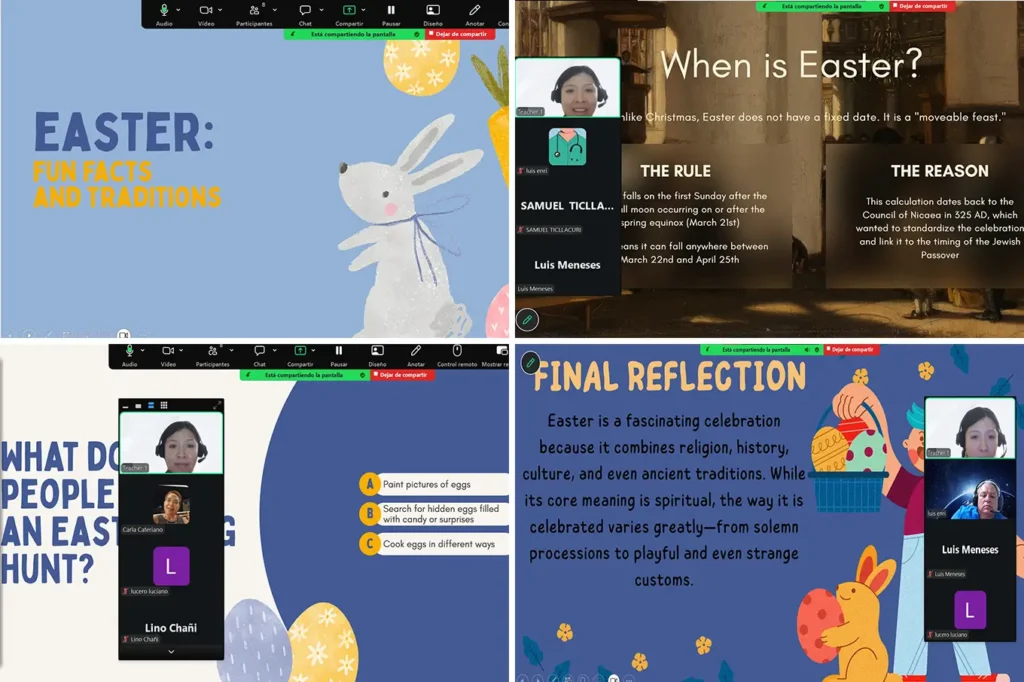
The session began with a welcoming introduction and a brief contextualization of the Social Club topic, “Easter Around the World.” I greeted the participants and expressed my appreciation for their attendance. To encourage initial engagement and activate prior knowledge, I asked a warm-up question: “What do you know about Easter and how is it celebrated in your country?” Participants shared ideas related to religion, family traditions, and common symbols such as eggs and the Easter Bunny. This interaction allowed me to assess their familiarity with the topic and establish a meaningful starting point for the presentation.
Following the warm-up activity, I introduced the first section, which focused on the definition and significance of Easter. I explained that Easter is the oldest and most important Christian holiday, commemorating the Resurrection of Jesus Christ three days after his crucifixion. I emphasized its importance as the foundation of Christian faith, representing hope, renewal, and eternal life. Additionally, I clarified that Easter is a moveable feast, as its date varies each year based on the lunar calendar, specifically occurring on the first Sunday after the first full moon following the spring equinox. I also briefly mentioned its historical standardization during the Council of Nicaea in 325 AD.
In the second part of the session, I explored the biblical foundations of Easter. I explained how the Resurrection is recounted in the four Gospels:Matthew, Mark, Luke, and John; highlighting key shared elements such as the empty tomb and Jesus appearing to his followers. This section aimed to provide participants with a deeper understanding of the religious significance of Easter and its theological basis. I also introduced the concept of the Easter Vigil, describing its main components, including the Service of Light, the Liturgy of the Word, and the Liturgy of Baptism, emphasizing its importance as one of the most solemn celebrations in the Christian tradition.
Afterward, I moved on to explain Easter symbols and their meanings. I described how elements such as the cross, Easter eggs, and lilies represent themes of resurrection, purity, and new life. I elaborated on the symbolism of the Easter egg, explaining how its shell represents the sealed tomb of Jesus, while the emerging chick symbolizes resurrection and new life. Furthermore, I discussed the origin of the Easter Bunny, linking it to ancient pagan traditions and its association with fertility and renewal. This section allowed participants to understand how religious and cultural elements have blended over time.
In the following section, I introduced key vocabulary related to Easter, including terms such as Easter, Lent, Holy Week, Resurrection, Crucifixion, faith, and church. I also presented vocabulary related to symbols, activities, and food, such as Easter egg, basket, candy, egg hunt, and lamb. I modeled pronunciation and meaning, encouraging participants to repeat and actively engage with the new terms. This vocabulary-building activity aimed to strengthen their confidence in discussing the topic in English.
Subsequently, I presented various traditions and fun facts about Easter. I highlighted interesting information, such as the large-scale production of chocolate bunnies and unique events like the Easter Egg Roll in the United States. I also explained common ways of celebrating Easter, including attending church services, organizing egg hunts, participating in parades, and sharing meals with family. To reinforce understanding, I introduced the tradition of the Easter egg hunt and explained the step-by-step process, including preparation, instructions, gameplay, and rules. This interactive component contributed to a more dynamic and engaging learning environment.
In the next part of the Social Club, I focused on global perspectives by describing how Easter is celebrated in different countries. I provided examples such as parades in Spain, family meals in Italy, egg decorations in Germany, and the Easter Bilby in Australia. I also highlighted more unique or extreme traditions, such as reenactments in the Philippines, religious events in Mexico, food blessing customs in Poland, and unusual practices like reading crime novels in Norway or throwing pots in Greece. This section emphasized cultural diversity and encouraged participants to appreciate different global traditions.
To consolidate learning, I conducted an interactive quiz that included multiple-choice and open-ended questions about the content presented. Participants answered questions related to symbols, traditions, vocabulary, and general knowledge about Easter. This activity allowed me to assess comprehension and reinforce key concepts in an enjoyable and participatory manner.
To conclude the Social Club, I provided a final reflection summarizing the main ideas discussed: the religious significance of Easter, its historical background, its symbols and meanings, and the diversity of its global celebrations. I emphasized that Easter is a multifaceted celebration that combines religion, culture, and tradition. Finally, I encouraged participants to continue practicing the vocabulary learned and to reflect on how cultural celebrations can vary across the world while sharing common themes.
Overall, the objective of the Social Club was to deliver an informative, interactive, and culturally enriching session that enhanced participants’ understanding of Easter while strengthening their ability to discuss the topic in English.