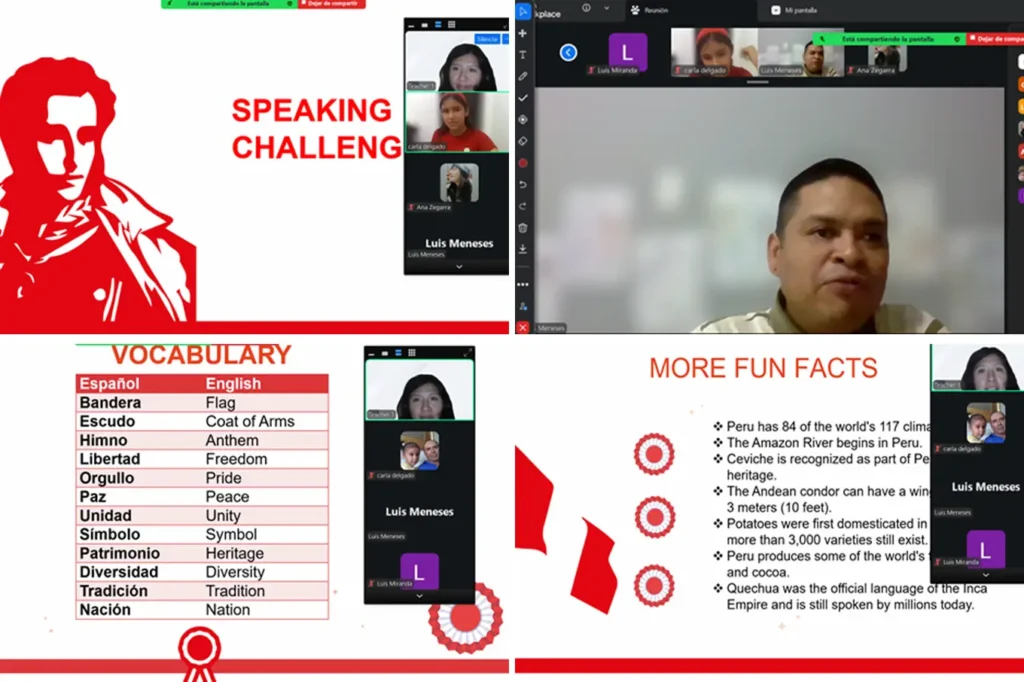
The session began with a warm welcome, and I introduced the topic of Peru’s Independence Day by asking students what they already knew about the celebration. We briefly discussed why Peru celebrates Independence Day on July 28th and why these dates are so important for the country.
After the introduction, I gave a general overview of Peru’s history and the significance of the Independence Day celebrations. I explained the events commemorated on July 28th and 29th, including José de San Martín’s proclamation of independence in 1821 and the importance of honoring the Armed Forces and National Police during the Military Parade. I also outlined the topics we would explore throughout the session.
Next, we explored Peru’s historical development, beginning with the earliest civilizations such as Caral, Chavín, Nazca, Moche, Wari, and Chimú, before moving on to the rise of the Inca Empire. Students learned about the Incas’ agricultural techniques, the Qhapaq Ñan road system, the use of quipus, and the historical importance of Machu Picchu. We then discussed the Spanish conquest, the Viceroyalty of Peru, the independence movement, and the contributions of important historical figures, including Túpac Amaru II, José de San Martín, and Simón Bolívar. The historical overview concluded with the Battles of Junín and Ayacucho, which marked the final stage of Peru’s independence.
The session also included a section on Peru’s national symbols, where students learned about the flag, the coat of arms, and the national anthem, as well as their significance in representing the country’s identity. We also explored Peru’s cultural diversity, UNESCO World Heritage Sites, traditional cuisine, and some of the customs associated with Independence Day celebrations.
To keep the session interactive and encourage participation, I included a variety of activities throughout the lesson. Students took part in Peru-themed trivia, True or False questions, the «Who Am I?» guessing game, «Guess the Place,» matching activities, general knowledge questions, and short speaking challenges. These activities gave them opportunities to review historical information, expand their vocabulary, practice speaking, and interact with their classmates in a relaxed and engaging environment.
To wrap up the session, we reflected on the importance of understanding Peru’s history, valuing its cultural diversity, and recognizing the principles of freedom, unity, and national identity represented by Independence Day. Overall, the session provided students with an engaging and interactive learning experience while helping them develop both their English communication skills and their knowledge of Peruvian history and culture.